Master Secrets

Monday, August 29, 2011

The Wrath of Dragons in Vietnamese Art

The influence of symbolism in Vietnamese art has been in vogue since prehistoric times. One of the most supernatural of all creatures, dragons and fairies, symbolized various instances of Vietnamese art. From the Dong Son civilization to the modern Nyugen Dynasty, the dragon motif has been used in various forms and shapes in sculptures, paintings, palaces, and different religious or architectural structures.


The evolution of the dragon symbol portrayed the changing beliefs and culture of the people from time to time.

The Dong Son civilization (400BC to 200AD) saw the reptile version of the dragon, also known as the "Giao Long" dragon. This symbol was found etched on a number of bronze urns and weapon hatches. The following period (Dai La) witnessed Vietnam under Chinese colonization from the first to the tenth century. This period had a profound impact on Vietnamese art. This is clearly evident from the decorative tiles found at Co Loa, where the Dai La dragon shows remarkable resemblance with its Chinese counterpart.

Vietnam breathed the air of independence with the dawn of the Ly Dynasty.


This period can also be termed the 'golden period' for Vietnamese art as it reached the peak of excellence. Water dragons symbolizing the God of Rain found way into Vietnamese art during this period. Some of the distinguishing features of this dragon in contrast to the Chinese creature were: thin and long body; undulated body contours of a serpent; small head with long whisker and mane and fine legs with small claws. The Chuong Son tower now showcases an extraordinary example of the Ly dragon carved on stone.

The heritage of the Ly Dynasty was transferred to the later Tran Dynasty (13-14th century). The fire-gurgling creature during this period still appeared with a small head and body; an instance of which can be found in the Pho Minh temple.

The influence of Chinese culture and heritage rose profoundly in the later Ly Dynasty, with Chinese emperors adopting Confucianism, Buddhism, and Taoism. As a consequence, the dragon symbol came to be associated with the emperor and his authoritative powers. The dragon motif then began to be extensively used in tombs, and religious temples. Dragons of the later Ly Dynasty also owes greatly to the Chinese influence. Large head, gigantic body, thick scales, long sharp claws, thick mane, and a beastly glance summarize the appearance of the Ly dragon.

The modern Nyugen Dynasty hails from the "Tu Linh"- the four mythical Chinese creatures namely the phoenix, the dragon, the lion, and the tortoise. These creatures were collectively portrayed in numerous paintings, sculptures, royal palaces, and tombs in Hue.

These fiery dragon motifs have attracted the attention of connoisseurs all over the world. Art gallery in Vietnam showcases these mythical creatures in their changing moods. Imbibing the Chinese motif, Vietnamese art have become even more alluring.

Suzanne Macguire is an expert writer with keen interest in contemporary art.

The Chinese New Year Parade

All Chinese communities go ecstatic and extravagant during Chinese New Year. One of the highlights of this is events the Chinese New Year parade. The Chinese New Year Parade continues to amaze and delight the millions who witness it year after year and remains to be one of the most inspiring, most widely-celebrated events.


The Chinese New Year parade is indeed grand in every sense of the word. The young, the old, the rich and the poor crowd the streets to watch the event with excitement. The showcase of lion and dragon dances, street performers, colorful costumes, strings of fireworks, and the happy faces all make the annual parade and Chinese New Year celebration truly unforgettable.


The lion dance symbolizes the bringing in of good fortune. As the performers dance through the streets, people are also entertained by the drums and gongs. These instruments create the lively and dynamic sounds that accompany the Lion Dance. The Chinese people believe the loud drum beats awaken the legendary animal and ward off evil spirits.

Millions of spectators are also wowed by the brilliant sparkles and fireworks display as no Chinese New Year Parade is complete without them. Loud firecrackers are also set off around the lion and the dragon to banish ghosts.

In China, the dragon is considered a popular symbol for power, wisdom and luck. This is why most, if not all, Chinese people believe that they are descendants of the dragon. In the Chinese New Year Parade, the dragon is the biggest attraction. The dragon used for the special event is usually made from silk, bamboo and other colorful materials. The dragon can be as long as 100 to 200 ft. and can be carried by 50 young men on poles. It is a belief that the longer the dragon is, the better the year would be.


The Chinese New Year Parade is also where East meets West. This is because the Chinese New Year Parade also features other Non-Chinese traditions. Aside from the symbolic lion and Golden Dragon dance, the parade also features non-Chinese activities like the beauty pageant. Many people come to see the newly crowned Ms. Chinatown and her court along with the colorful Chinese-themed floats, marching bands and other Asian groups that join the parade.
How it All Started

During San Francisco's Gold Rush period, over 50,000 hopefuls came to work in the mines hoping for a better life. Among them were Chinese immigrants who later on formed friendships and ties with everyone else. These Chinese immigrants soon shared their unique culture by using the good old-fashioned American Parade. Through the help of other groups from different parts of the city, they were able to promote the rich Chinese culture.


Today, all Chinatowns across the world celebrate Chinese New Year with festivals and parades with the San Francisco Chinese New Year Parade as the grandest of its kind outside of Asia. The Chinese New Year Parade has indeed come a long way.

Ray Ritchey is the owner of the site ChildBook.com which for over 12 years has been helping Children in the United States learn more about Chinese Culture and Language. You can read more about Chinese New Year at Childbook.com

The Chinese Dragon Dance

One of the highlights of the Chinese New Year celebration is the spectacular Dragon Dance. It's history goes back to the Han Dynasty (180 - 230 CE) in ancient China. The Chinese have always perceived the dragon as being sacred and possessing power, courage, righteousness, dignity, fertility, wisdom, and auspiciousness.

New Year festivities celebrate the outset of the planting season in China.


The dragon represents rain and good fortune, elements crucial for the agricultural crops. This mythical beast takes the physical form of many animals; it has the horns of a stag, the ears of a bull, the eyes of a rabbit, the claws of a tiger, and the scales of a fish distributed along the body of a long serpent. It was believed these combined traits allowed the creature to walk on land, fly through the heavens, and swim through the waters. These powers gives the dragon the authority to rule the clouds and to control the rain.

The Dragon Dance requires the coordinated efforts of a team of dancers who come from martial arts groups. The dragon consists of a head mask and a lengthy body which is held up with poles and transported by the dancers. The lead dancer holding the dragon's head has an extremely important job. He or she makes the dragon twist, leap, crouch, and dip, as sinuous as a snake.

The dragon mask itself, usually colored red, green, or gold, is gorgeous and very complex in design. Sometimes the head has animation and pyrotechnics that belch smoke. The number of body sections can vary, sometimes using as many as 25 sections divided by hoops of bamboo. The longer the dragon, the more good fortune.

The dragon is difficult to manipulate and requires well-trained dancers in top physical condition. The creature moves in precise patterns to the music provided by drums, cymbals, and a gong. Onlookers throw firecrackers at the dancing dragon's feet to scare away any evil spirits and also to assure the beast is fully awake from its hibernation.

The color green on the dragon stands for an extraordinary harvest, yellow is for the solemn empire, prosperity is represented by gold or silver, red is excitement, and the dragon's scales and tail are a shimmering silver symbolizing joy.

At times, at larger celebrations, a spectator might see a Double Dragon Dance where two groups of dancers intertwine their dragons in intricate patterns. A truly rare performance involves nine dragons (Kawlung) because nine is a "perfect" number. However, such performances necessitate the coordinated efforts of several dance troupe.

Hopefully, visitors to Chinatown will have the opportunity to observe the breathtaking, astounding Dragon Dance.

See more on holidays at Niftykitchen.com Food and Cooking Tips. Terry Kaufman also writes for Niftyhomebar.com & Niftygarden.com

©2008 Terry Kaufman

Introduction To Chinese Astrology: A Brief Presentation Of The First Six Chinese Horoscope Signs

Here is a brief presentation of the first six of the twelve Chinese Horoscope signs, their nature, characteristics and attributes. I will present them as ordered by the supreme Chinese gods that created Chinese Astrology and the Chinese calendar system. The first six Chinese horoscope animal signs are: Rat, Ox, Tiger, Rabbit, Dragon, Snake. Here we go.

Rat (Yang-male nature)


The Rat is the very first animal of the Chinese Horoscope Cycle. A Rat is good at leading and conquering. Many famous emperors of Chinese history where Rats. Being able to charm others, Rat people are generally charismatic and full of passion. What makes them unique is their practical and dominant mind which gives them the ability to be organized, tactful and systematic. The other side of a Rat can reveal a very controlling person who always insists in doing everything its own way, at all costs. A Rat can also be very cruel and dangerous, especially when challenged. People under this major Chinese Horoscope sign are well known for their ability to use their master minds to exploit other's emotions, feelings and thoughts.

Ox (Yin-female nature)

The Ox is a powerful Chinese Horoscope sign which symbolizes wealth and prosperity. Ox people are usually very hard working and stubborn. Being admirer of power and possession, this Chinese Horoscope sign like to depend on itself to achieve all kinds of great things. Ox people are also a bit slow when making their decisions, especially if they are given a lot of options to choose from. Once they decide on something though, nobody can make them go another way. You can't easily get an Ox person to speak to you, but once you earn their trust, they will open their heart and mind in a very sincere and true way. An Ox can be a good and loyal friend.

Tiger (Yang-male nature)


Chinese astrologers consider the Tigers (not the lions) as kings of all animals. Tiger people are usually very attractive and persuasive. You cannot resist them easily and at the same time, you cannot attract their interest unless you try hard and be sincere. They like mystery, fairy tales and stories about courage and love. They will likely spend an adventurous life triggered by their instincts and strong emotions. Another important attribute of people under the Chinese Horoscope sign of Tiger, is the fact that they like surprises and out of the ordinary situations. If you want to have a Tiger as a friend then it's up to you to make sure your friendship will last since a Tiger will generally find it hard to maintain any relationship.

Rabbit (Yin-female nature)

The Rabbit is well known for its ability to attract good fortune and be lucky. Rabbit people, apart from being attractive to the opposite sex, they are also very good at solving complex situations and problems. Many well known Chinese politicians and diplomats belong to the Rabbit. Another aspect of this Chinese Horoscope sign reveals tendency to cultural activities and the arts. A Rabbit hates fighting and engaging in aggressive behaviors or activities because of its peaceful nature. Last but not least, Rabbit people hate surprises or unpredicted results and you may annoy them if you try to involve them in any risky situation. That is why it is likely that Rabbit people will miss several good chances in their lives.

Dragon (Yang-male nature)

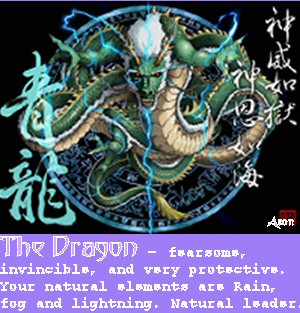
Dragons are mythical powerful creatures worshiped by Chinese culture. A Dragon symbolizes strength, health, harmony and intellectuality. Many consider Dragon people extremely lucky and blessed. People under this eccentric Chinese Horoscope sign are generally charismatic and gifted with great powers. It is unlikely for a Dragon to go unnoticed from a social meeting or a party. Their unique attitude and self confidence will always work wonders in such situations. Dragon people are also well known for their honesty and sense of duty. These characteristics can sometime work against them because others will tend to take advantage of them. If a Dragon is your friend feel free to confide in them.

Snake (Yin-female nature)

The Snake (Serpent) is strongly related with deep and eternal wisdom. Snake people are always enigmatic and maybe the most wise of all Chinese Horoscope signs. A Snake usually evolves to become a philosopher, deep thinker, theosophist, magician or leader of the back scene. Snake people love learning, reading and eating good food. They are also very concerned about their outer appearance. Their best attribute is their excellent ability to communicate with others and successfully engage in interesting conversations. Snake people love new ideas and innovative thoughts and actions, but they will usually reject advice from anyone but themselves.

Ewyen Minh is an eccentric Chinese Astrologer with over 30 years of experience in divination and the Chinese Zodiac system. Learn more about The Twelve Chinese Horoscope Signs or visit Ewyen's website about Chinese Astrology.

Saturday, August 27, 2011

Dragons Through History

The Dragon has played an important part in myths and religions since pre-historic times. The history of dragons goes back at least six thousand years, and there are dragon tales and legends from every continent except Antarctica. In almost every culture, and all throughout history, there are stories of these mythical and magical creatures called dragons. Different people have various theories of why so many cultures developed such a long lasting belief in dragons; however, none can actually be proven.

Many believe that dragons were what we now call dinausaurs. It may be that dragon stories partly grew out of people finding dinosaur bones. The thought is that when dragon bones were dug up later, they were given the new classification of dinosaur. Many evolutionists believe that dinosaurs became extinct millions of years before man walked the planet, while others claims dispute this. It is said that dinosaur fossils, which have been discovered along with human footprints and remains, add proof to the ancient people's history of dragons. Others feel that people forgot that dragons were ever real, and quickly faded into mythology.


In almost every culture and all throughout history there are stories of these magical creatures called dragons. Later, in Europe these dragons in art forms were thought to be real life animals rather than symbols of evil.

Throughout many cultures, dragons may have appeared different, but they have always retained the same basic core elements. When most people think of dragons they generally think of fire breathing monsters, but originally dragons were usually connected with water. To the ancient Chinese, dragons were not creatures of fire, as so many would think, but rather creatures of water. The dragon of the Chinese resided in rivers, lakes, pools and rose in great clouds of mist to promote rainfall. In earlier Mideast stories, the dragons are most often associated with water and wisdom. Historians use this conection with water to distinguish dragons from other mythical animals.

While the east feels that the dragon is a divine, mythical creature that brings good fortune, prosperity and bounty, western dragons are viewed differently. They are connected to the element fire, and they fling their colossal tails about, and viciously create destruction. The contrary views of the east and the west indicate opposing views where humans viewed dragons as a symbols of wisdom and peace, or symbols of chaos and evil. Neither would disagree that dragons were viewed as powerful creatures. This, along with the wide variance in the physical description of dragons, contributes to confusion in the definition of a dragon.

The humans revered the dragons, some clans even calling them gods. Hence, dragons were held in high regard, and their images kept and worn, to win their approval. Originally, it was believed that dragons were the ones who talked directory to the Gods. It was also thought at this time that earthquakes were caused by battles between dragons and gods. In history, many different cultures began to adopt the idea of gods fighting with dragons to restore order.

The dragon may be ancient, but it remains as influential today as it did four thousand years ago. Today, the popularity of fantasy, and such role-playing games as Dungeons and Dragons, means that dragon figurines are a hot commodity.

Online stores promoting dragon items have popped up including http://www.dragon-gifts.com

Here There Be Dragons – The Symbolism Of Dragon Lore In Western History

The first appearance of dragons in Western mythology was the Norse worm, a large scaled creature that was able to breathe fire and regenerate itself if vivisected. It didnt have the arms, legs, or wings of later dragon stories, but was often pictured as an enormous snake. Because these multihued dragons were often seen streaking across the sky, many of these worm dragons sightings have been attributed to the natural ball lightening phenomena that occurs during some thunderstorms...
Here There Be Dragons – The Symbolism Of Dragon Lore In Western History


Dragon – the Ultimate Good Fortune Feng Shui Symbol

The mighty and magnificent Dragon of mythical folklore never ceases to enchant or stir the imagination. The Dragon is one of the four celestial animals and is important and powerful symbols in Feng Shui. The Dragon represents the ultimate ‘Yang’ symbol, male vigor, courage and bravery. It is magnanimous and full of vitality and strength. Affiliated with the cardinal direction “East” based on Landscape Feng Shui, the Dragon becomes a very powerful and potent symbol when placed in this sector, although it can be placed in any other directions.

In Chinese culture and in Feng Shui, the dragon is the most auspicious and magnificent, mightiest and most sacred of all creatures and to be treated with great respect. Through generations, the dragon has been the ultimate symbol of power, abundance, good luck and honor. In ancient times, the Emperors of China regarded themselves as the Dragons and the symbol of Dragons can only be used by the them and no one else.


The Dragon is said to create the precious cosmic Chi or known as the ‘Sheng Chi’ which brings good fortunes into our homes and workplaces, making it an all-rounder bringer of good luck. The Dragons are a powerful cure and enhancer for business luck, brings foresight and wisdom for the elderly, brings honor to the family, protects the wearer and paves the way for more accolades in coming years.

The Dragon frequently appears in carvings or statues holding a ball, or pearl. This can symbolize success and victory in wealth attainment and career achievement..

In Chinese Astrology, the Dragon is the fifth sign of the Chinese Zodiac and its intrinsic element is earth. The compass direction of the Dragon is 97.5 degrees to 127.5 degrees. Its allies are the Rat and the Monkey and the Rooster is its secret friend.

In Feng Shui, Dragons can be placed in many areas of the home or office to guard, protect, bring strength and fortune, and to activate masculine energy. Here is how you can use the Dragon to Feng Shui your way to a better life.

1. For people born in the year of Dragon, place the Dragon on your work or study desk, in the sector between 97.5 degrees to 127.5 degrees of your house, or in the Rat or the Monkey sector (allies of Dragon) to energize your personal good wealth luck.

2. Based on the Pakua’s 8 Life Aspirations Method, place the Dragon in the Northwest sector of your home to favor patriarch’s luck. This will also bring powerful friends, mentors and advisors into your life.

3. Place the Dragon near your water features like aquarium or fountains for those craving for good fortune, advancement in their career or seeking fame and recognition. You will experience new opportunities and better luck.

4. Place the Dragon in the North sector to enhance your career luck. It will help you up a few prongs of your career ladder.

5. It is an excellent idea to activate the dragon by placing a dragon in the East sector of your home or living room to bring good health and harmony to the residents of the house.

6. For career luck and those seeking continuous achievement, place a Dragon figurine on the table, cabinet or in the East sector of your office or study. Your professional luck will look rosy.

7. In Flying Star Feng Shui, the Dragon made from metal (brass, bronze, pewter, cloisonné etc.) can be used to ward-off the evil influences of the malignant #5 yellow star and #2 black star. The #2 black star is also known as the ‘Sickness Star’ which brings illnesses and ailments to occupants while the #5 yellow star is the ‘Disaster Star’ that instigates fights, accidents and death. Placing the metallic Dragon in the affected sectors will dissolve these adverse energies.

* Do not place any representation of the dragon inside the bedroom as the Dragon is the ultimate ‘yang’ symbol and is not suitable for a place of rest where ‘yin’ is preferred.

** Try not to place the Dragon higher than our eye level to ensure they are under our control.

** Never place the Dragon in the toilet of bathroom.